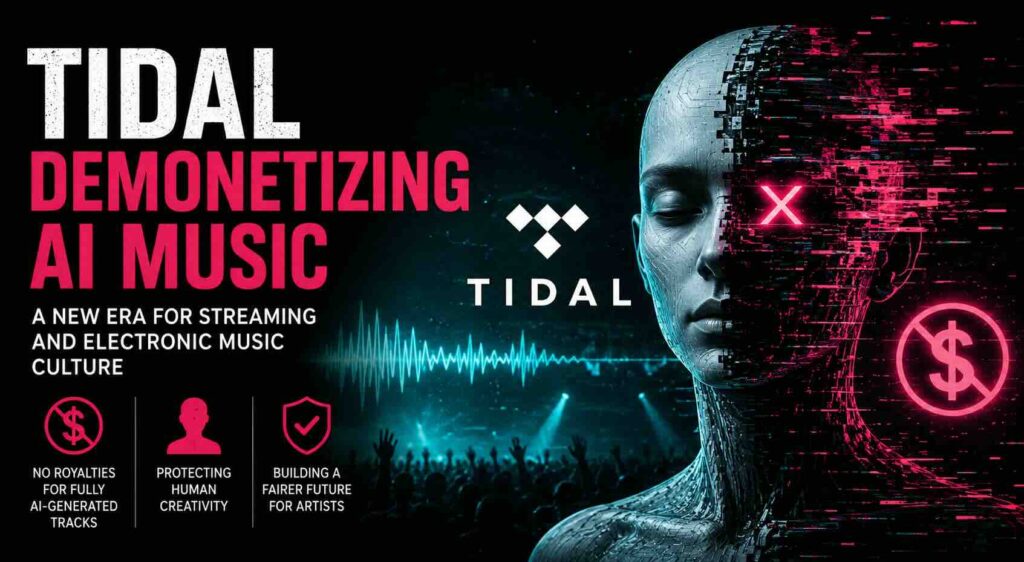
The relationship between AI-generated music and streaming platforms just took a sharp turn. As of late June 2026, TIDAL has officially announced a policy that removes monetization from fully AI-generated tracks, marking one of the strongest industry stances yet against the rise of “AI slop” in music streaming.
For EDM producers, digital artists, and electronic music fans, this move could reshape how AI tools are used, shared, and valued across the ecosystem.
TIDAL’s New AI Music Policy Explained
TIDAL’s updated policy allows AI-generated music on the platform, but introduces strict limitations on how it is treated financially and algorithmically.
According to the company’s official guidelines, AI-generated music is defined as tracks that are fully created using generative AI systems. These tracks will still be allowed on the platform—but with major restrictions.
Starting July 15, 2026, TIDAL will:
- Label tracks identified as fully AI-generated
- Prevent those tracks from earning royalties
- Expand enforcement as detection tools improve
- Remove or block AI content linked to impersonation or fraud
In TIDAL’s words, royalties are being reserved for “organic creativity”—music directly written, performed, and produced by humans.
Why TIDAL Is Doing This
The rise of AI music generators like Suno-style tools has flooded streaming platforms with large volumes of automated content. Much of it is low-effort, mass-produced, and designed to game algorithms rather than contribute artistically.
TIDAL says the goal is to protect:
- Human artists’ income streams
- Listener trust in recommendations
- Platform integrity against fraud and impersonation
As TIDAL EVP Tony Gervino put it, the policy is about protecting “organic creativity” and ensuring artists can still build genuine connections with fans.
The Bigger Industry Context
TIDAL isn’t acting alone.
Across the streaming world, platforms are scrambling to respond to the explosion of AI-generated tracks:
- Deezer has implemented AI detection systems and flags synthetic music
- Spotify has introduced labeling systems and restrictions on AI-only profiles
- YouTube Music and others are also experimenting with transparency tools
The broader concern is not just creativity—but economics. AI-generated uploads are often designed to exploit streaming payouts, potentially diluting royalties for real artists.
Academic research also suggests that AI music is increasingly used in “spam-like” production cycles where tracks are mass-uploaded and optimized for algorithmic exposure rather than artistic intent.
What This Means for EDM and Producers
For the EDM and electronic music world, this policy could have mixed but important implications.
1. Human Producers Gain More Value
By cutting monetization for fully AI-generated tracks, TIDAL is effectively reinforcing the value of human-made production—something EDM culture has always been rooted in, from DJ performance to sound design experimentation.
2. AI Tools Are Not Banned—But Reframed
AI is still allowed as a creative tool. The distinction is whether the final output is fully AI-generated vs. human-directed production.
That means AI-assisted synthesis, sound design, and ideation may still be part of workflows—but “prompt-only” AI tracks lose financial viability.
3. A Shift in Release Strategy May Follow
Artists experimenting with AI-only releases may begin:
- Moving to self-hosted platforms
- Using hybrid human-AI workflows
- Or explicitly disclosing AI involvement for transparency
The Debate: Innovation vs. Control
Not everyone agrees with TIDAL’s approach.
Critics argue:
- AI music is still creativity, even if assisted
- Detection systems may incorrectly flag human work
- Monetization bans could slow innovation in digital music production
Supporters counter that:
- Streaming royalties should prioritize human labor
- AI spam threatens discovery systems
- Fraudulent streaming activity is already a growing problem
This tension is likely to define the next phase of music distribution as generative AI becomes more advanced.
Final Thoughts
TIDAL’s decision is not a ban on AI music—but it is a clear economic boundary.
AI-generated tracks can still exist, still be heard, and still spread across playlists. But they will no longer directly participate in the royalty economy—at least on TIDAL.
For EDM producers and digital artists, this signals a broader shift: the industry is starting to define what counts as “creative labor” in an era where machines can produce entire tracks in seconds.
And that definition is only going to become more important from here.